
The World of L-series Lenses

The Ultimate Integration of Canon Optical Technologies
A thin red line circles the lens barrel.
This red line symbolizes the superior image depiction, operating performance and trustworthiness of professional-grade Canon “L” lenses. The “L” stands for Luxury, and it is only assigned to lenses that feature truly superior optical elements, such as fluorite lenses and high-performance aspherical lenses. Canon introduced the first “L” lens in 1978. The advances introduced with this lens have been continued and refined in the EF series, and now the RF series of lenses. This section looks back at the history and purpose of L-Series Lenses.


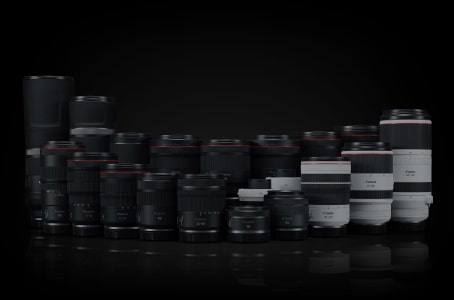
The Origin of the “L”
Canon traces its history of manufacturing interchangeable lenses back to 1946. The first lens developed and produced in-house was the Serenar 50mm f/3.5 I. Just five years later it followed up with the Serenar 50mm f/1.8 I, which amazed lens designers around the world with its high resolution, and earned a top-class reputation. Canon’s optical technology captured the attention of photographers around the world.
Canon’s first venture into the field of SLR cameras came in 1959. Canon Mount interchangeable lenses were introduced at the same time, establishing the company as a major manufacturer of both cameras and lenses, while also earning Canon a reputation for bold innovation and new technologies.
In 1969, Canon began using fluorite materials in its camera lenses, which have properties not found in conventional optical glass. The first lens to use fluorite, the FL-F300mm f/5.6, became an icon of high-performance lenses. This could be considered the first lens to exhibit the peak quality of the “L” brand. At the time, “special optical lenses” (which includes lenses containing fluorite elements) were designated by a green line on the barrels of the lenses. In 1971, Canon’s mount system evolved into the FD mount. The FD55mm f/1.2AL lens, which was released at the same time as FD mount cameras, captured the attention of photo enthusiasts with the world’s first aspherical lens elements for an SLR camera without a retractable mirror. The word “ASPHERICAL” was engraved in gold letters on all interchangeable lenses that employed a ground aspherical lens. This soon became a symbol of lens quality, for professional photographers.

Fluorite
Canon Crosses Into the “Red Line Era”
The red line first appeared on the groundbreaking FD 300mm f/4L lens, introduced in December 1978. Canon adopted this red line to signify a lens designed with special optical materials such as fluorite and ground aspherical lens elements. This marked the start of the “L-lens” series — an honorific title reserved for ultra-high-performance lenses.
The “L” stands for “Luxury” — an appropriate word for the superior optical design and quality of these lenses, which integrate Canon’s strengths in advanced optical theory and ultra-precision processing technology.
In order to earn the “L” label, each lens must achieve a world-class level of optical performance by employing special optical elements such as artificial crystal fluorite, ground aspherical lens elements, UD/Super UD lens elements, and/or large-diameter high-precision aspherical lens elements.
Recent advances in optical design have made it possible to achieve superior optical performance even without the use of these special materials. However, any lens that earns the “L” mark must achieve performance levels that are the best in its class. This includes not only optical performance, but also the quality of the lens drive system, its operability, environmental resistance, and robustness. All of these must meet the high standards of professionals. Canon also expects the housing of L lenses to be as compact and lightweight as possible while maintaining excellent operability, even as optical performance is improved. When it comes to L-Series lenses, Canon insists on the highest level of quality even in terms of processing, tolerance control and production technology.
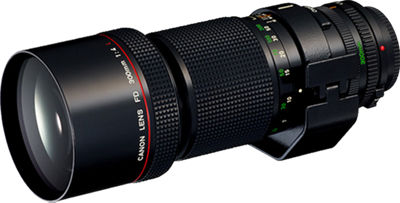
FD300mm F4L
The Famous White Barrel
In any discussion of L-Series lenses we cannot avoid talking about the famous “white barrel”. For more than half a century, Canon has been coating the barrel of its telephoto lenses with a white material that immediately stands out. It all began in 1960, when the white coating was adopted for the TV 2000mm 1:11.0 mirror lens, for broadcast cameras. Telephoto lenses for SLR cameras adopted the same coating in 1976. But why white? The answer is obvious. White coating protects the lens from heat. When a super-telephoto lens is set on a tripod and left in the blazing sun for long periods of time, the temperature may rise so high that it can degrade optical performance. Canon painted the barrels of its telephoto lenses white in order to minimize this problem.
Over the years, the exact shade of white used on Canon lens barrels has changed slightly. In recent years, infrared-reflective pigments have been introduced to increase the reflectivity of sunlight (particularly infrared rays) and thus minimize the problem of absorbed heat. A newly developed thermal barrier paint, which differs in color from the old white coating, uses infrared-reflective pigments instead of carbon black to further increase the reflectivity. The paint is scratch resistant and weather resistant, and resists discoloration even when exposed to light for long periods of time. Canon continues to pursue even higher performance from its white barrel coating.
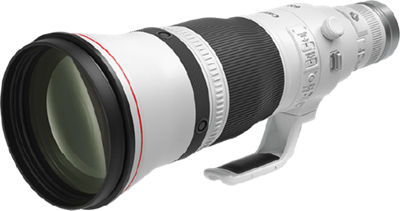
White Lens
The Ultimate Goal of the L Series: To Surpass All Expectations
As lens design has advanced, from the EF mount design to that of the RF mount, so has the technology used in Canon’s L-Series of lenses. One of Canon’s most representative series of zoom lenses — the f/2.8 L series — has evolved in step with the technical progress of professional-grade cameras, from the EOS-1 series to the EOS 5 series. The f/4 L zoom series, meanwhile, was developed to be a more compact and mobile series of zoom lenses, that still maintaining the high image quality of the f/2.8 L series. This offers photographers a wider range of choices and possibilities.
The demands on lens performance have progressed with the times, yet the L-Series continues to meet these demands as one would expect from Canon’s top lens brand. Yet we continue to seek ways to provide “better expression” and “better results” so that the finished photos will capture the attention, and convey emotional depth to those who view them.
Images are a cornerstone of culture. With its imaging technology, Canon wants to offer people better ways to capture, preserve and savor their culture. The L lenses help to make that possible.
Canon wants to take the experience of photography to a new level, and to offer users an unprecedented range of visual expression. Technical advances such as the RF mount allow L lenses to provide the superior image quality, improved specifications and increasingly compact and lightweight design that professional photographers demand. Canon’s focus may shift from one innovation or technical breakthrough to another. But the final picture is always a future where the “L” lens sets the top standard for imaging expression.

Thanks for signing up!
The application has encountered an unknown error. Please try again in a few minutes!
By clicking Sign Up, you are opting to receive promotional, educational, e-commerce and product registration emails from Canon USA. You can update your preferences or unsubscribe at anytime.