
When stepping away from a smartphone or an aging digital SLR to enter Canon’s RF mirrorless ecosystem, novice photographers and content creators are greeted by two compelling gateway options that promise real physical controls and interchangeable lenses. Sitting side by side at the entry level of the EOS R lineup are the EOS R100 and the EOS R50 cameras. While both lightweight cameras share a compact APS-C format and interchangeable lens flexibility, they cater to distinctly different photographer personas. One is stripped down to the fundamentals for traditional stills shooting, while the other packs cutting-edge video features, smart touch controls, and modern autofocus capabilities into a sleek, creator-focused body.
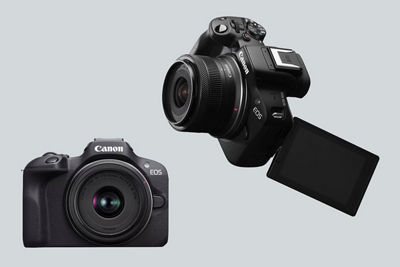
The Canon EOS R100 camera represents the most affordable and lightweight entry point into the entire EOS R family to date. Tipping the scales at roughly 12.5 ounces with a battery and memory card inserted, it is built to slip effortlessly into a jacket pocket or small hiking pack for everyday travel and snapshots. At its heart lies a 24.1 MP APS-C CMOS image sensor coupled with a DIGIC 8 processor. This combination captures crisp still photographs with natural background blur and impressive clarity, comfortably outpacing typical smartphone image sensors. For photographers who prefer a classic, tactile shooting experience, the R100 provides a comfortable physical handgrip, an integrated OLED electronic viewfinder with approximately 2.36 million dots, and a traditional physical button layout with a directional cross-key d-pad. With continuous shooting speeds reaching 6.5 frames per second in One-Shot AF mode, it comfortably handles casual family moments and everyday action.
Stepping up to the Canon EOS R50 camera, opens the door to a substantial jump in processing power and automated performance. Though still remarkably compact at approximately 13.2 ounces with battery and card, the R50 houses Canon’s advanced DIGIC X image processor paired with a refined 24.2 MP APS-C sensor. The DIGIC X engine unlocks dramatic gains in speed, enabling continuous burst shooting up to 12 frames per second with an electronic first-curtain shutter, and up to 15 frames per second when utilizing the full electronic shutter. Start-up time drops from 0.9 seconds on the R100 camera down to a swift 0.4 seconds on the R50, making it noticeably more responsive when capturing split-second moments. Furthermore, the R50 incorporates modern power conveniences such as in-camera battery charging and power supply over USB-C, whereas the R100 camera relies solely on an external wall charger.
One of the most profound contrasts between these two mirrorless bodies lies in their autofocus hardware and underlying intelligence. The EOS R100 camera utilizes standard Dual Pixel CMOS AF covering up to 88% horizontal by 100% vertical coverage, capable of detecting human faces and locking onto eyes during still shooting and Full HD recording. However, the EOS R50 upgrades to Dual Pixel CMOS AF II, offering complete 100% by one 100% frame coverage across up to 651 automatic zones. Driven by deep learning algorithms, the R50 automatically detects and tracks not just human eyes and faces, but also animals like dogs, cats, and birds, alongside vehicles such as race cars and motorcycles.
The physical interactive workflow marks another major divide between these two cameras. The EOS R100 camera employs a fixed 3.0” LCD display with approximately 1.04 million dots that completely lacks touch functionality, requiring users to navigate menus, select focus points, and adjust settings strictly via physical dials and buttons. By contrast, the EOS R50 camera features a 3” Vari-angle LCD with a sharper 1.62 million dot resolution and full touch-screen operation. This fully articulating flip screen rotates outward for self-vlogging, high-angle crowd shots, and low-angle creative framing. Its touch screen functionality supports intuitive smartphone-style gesture navigation, Touch AF, Touch Shutter, and Touch and Drag AF, allowing creators to reposition focus points effortlessly across the screen while looking through the electronic viewfinder.
For creators prioritizing video production, the performance gap widens significantly. The EOS R100 camera records 4K video at up to 24 frames per second, but the clip is cropped into the central region of the sensor and relies on slower contrast-based autofocus, which can cause focus hunting. In comparison, the EOS R50 records uncropped 4K video at up to 30 frames per second oversampled from a high-resolution 6K image capture, retaining full lens focal lengths and full Dual Pixel CMOS AF II tracking. While the R100 tops out Full HD video at 60 frames per second and limits slow-motion HD recording to 120 frames per second, the R50 camera upgrades slow-motion capture to Full HD 120 frames per second. In addition, the R50 removes the traditional 30-minute continuous recording limit for video clips up to an hour, introduces a specialized Movie for Close-up Demos mode for product reviewers, supports vertical movie metadata, and offers plug-and-play UVC/UAC webcam streaming over USB. The R100 lacks UVC/UAC streaming compatibility altogether.
Ultimately, deciding between the Canon EOS R100 and EOS R50 cameras comes down to workflow expectations and budget priorities. For photographers seeking a lightweight, uncomplicated camera for casual travel, family snapshots, and classic viewfinder photography at the lowest possible cost, the EOS R100 camera delivers reliable 24 M image quality without unnecessary complexity. But for vloggers, hybrid content creators, and action enthusiasts who demand touchscreen agility, advanced subject tracking, and crisp 4K video, the EOS R50 justifies its higher price tag by serving as a versatile, feature-rich creative tool.

Thanks for signing up!
The application has encountered an unknown error. Please try again in a few minutes!
By clicking Sign Up, you are opting to receive promotional, educational, e-commerce and product registration emails from Canon USA. You can update your preferences or unsubscribe at anytime.