
Today’s productions rarely end with a single deliverable. A project that premieres as a cinematic widescreen video may also need to appear on YouTube, Instagram Reels, TikTok, digital signage, or a company’s website. As content creators are increasingly asked to produce multiple versions of the same project, they’re looking for ways to maximize flexibility while minimizing their time on set.
One workflow that has become increasingly valuable begins with shooting in Open Gate. Rather than committing to a single aspect ratio during production, Open Gate captures the camera’s entire imaging sensor, giving editors greater creative flexibility while making it easier to create multiple deliverables from a single recording.
Whether you’re shooting a documentary, narrative film, commercial, corporate video or social media content, Open Gate recording can help future-proof your footage while streamlining the post-production process.
What Is Open Gate?
Open Gate recording uses the camera’s full imaging sensor instead of cropping it to a traditional video aspect ratio such as 16:9 or 17:9. The result is a 3:2 image, which is the same aspect ratio commonly used for still photography, that captures roughly 20 percent more vertical resolution than conventional video formats.
Think of it as recording the largest possible canvas. Instead of deciding exactly how every shot will be framed while you’re on location, you’re preserving additional image information that can be used later during editing.
It’s worth noting that Open Gate isn’t simply another recording resolution. Rather, it’s a combination of sensor mode and recording resolution that allows filmmakers to capture the sensor’s full height for maximum creative flexibility.
Why More Filmmakers Are Choosing Open Gate
As productions increasingly deliver content across multiple platforms, flexibility has become one of the most valuable assets in modern filmmaking.
A single interview may ultimately need to appear as a traditional 16:9 video on YouTube, a vertical 9:16 version for Instagram Reels or TikTok, a square version for other social media platforms, and perhaps even a custom aspect ratio for digital signage or a corporate presentation. Rather than shooting each version separately, Open Gate allows editors to create multiple deliverables from a single master recording. As organizations continue producing content for an ever-growing number of platforms, this saves both production time and budget. As one filmmaker fittingly described Open Gate, it’s a “deliverable multiplier.”
The Benefits of Open Gate
The flexibility that shooting in Open Gate offers is huge, both creatively and technically. However, there are a lot more advantages in addition to its ability to let you to create multiple aspect ratios from a single recording.
Freedom to Reframe
Open Gate also allows for greater freedom to reframe. It provides additional headroom and floor room, allowing editors to adjust composition during post-production without significantly sacrificing image quality.
That extra image area can also be used for subtle push-ins, horizon corrections, or minor camera repositioning that helps perfect a shot after production has wrapped.
Creative Flexibility
Filmmakers also have more room to experiment creatively.
Instead of locking every framing decision on set, directors and editors can continue refining compositions during post-production. That flexibility becomes especially valuable on documentaries, live events and other productions where moments cannot be recreated.
Ideal for Anamorphic Production
Open Gate is particularly valuable when shooting with full-frame anamorphic lenses.
Because the camera records the sensor’s full height, filmmakers can maximize the available image area while taking advantage of in-camera anamorphic de-squeeze options for multiple squeeze factors. This allows productions to fully realize the cinematic look anamorphic lenses are known for without sacrificing valuable image information.
Who Benefits Most?
The short answer is just about everyone.
Narrative filmmakers appreciate the additional creative options available during editing. Documentary crews value the ability to reframe interviews, create subtle push-ins, and adapt footage for multiple screening formats after production.
Commercial and corporate production teams often need to deliver content across multiple platforms and greatly benefit from one shoot in Open Gate that allows for a variety of final deliverables.
Content creators and event videographers also benefit from the ability to produce both horizontal and vertical content from the same footage, making it possible for one camera to effectively replace what previously required separate production workflows.
Shooting for Post-Production Success
One of the reasons Open Gate has become so popular is that it shifts creative flexibility into post-production.
Editors gain additional room for stabilization, reframing and aspect ratio adjustments while maintaining excellent image quality. Canon’s Cinema RAW Light recording format further enhances this workflow by providing files designed for efficient post-production without compromising image quality.
For productions that regularly create content for multiple platforms, Open Gate offers an efficient way to maximize the value of every shoot.
Open Gate with Canon Cameras
If the final deliverable will ultimately be cropped to 16:9, operators naturally need to know what portion of the image will remain in the finished project.
Canon Cinema EOS cameras address this with Aspect Markers and User Markers, allowing operators to display frame guides for multiple delivery formats while still recording the full Open Gate image. These markers make it easy to compose shots confidently while preserving the additional image area around the frame.
For productions requiring precise communication between set and post-production, reference photos or framing charts can also help ensure editors apply crops exactly as intended.
Setting Your Camera to Open Gate
Canon currently supports Open Gate recording on its Cinema EOS C50 and EOS C400 cameras. You can enable this by selecting Full Frame 3:2 in each camera’s Sensor Mode menu.
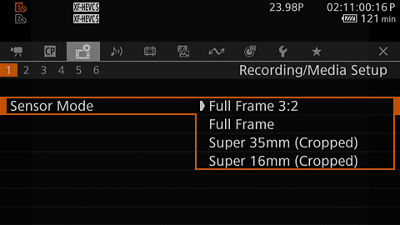
On the EOS C50, Open Gate records at 6960 × 4640 in Cinema RAW Light or 6912 × 4608 using XF-HEVC S. The EOS C400 records Open Gate in Cinema RAW Light at 6000 × 4000.
After selecting Full Frame 3:2, it’s helpful to configure Aspect Markers and/or User Markers in the Assistance menu so camera operators can visualize the intended delivery format while recording the full sensor image.
Once configured, shooting in Open Gate is very similar to a traditional production workflow. Canon’s Dual Pixel CMOS AF II with subject tracking continues to operate normally, allowing filmmakers to take advantage of Canon’s advanced autofocus capabilities while recording the full sensor.
Tradeoffs to Consider
Like any production workflow, Open Gate involves a few practical considerations.
Because the camera records more image data than a traditional 16:9 capture, data rates increase by roughly 25 percent. However, on the Cinema EOS C50 and EOS C400, memory card requirements remain unchanged.
For many filmmakers, these tradeoffs are minor compared to the creative flexibility Open Gate provides. As productions continue to expand across streaming, social media and emerging platforms, the ability to create multiple deliverables from a single recording is becoming less of a convenience and more of a competitive advantage. By capturing the entire sensor once, Open Gate gives filmmakers the freedom to decide later how their story is best told.

Thanks for signing up!
The application has encountered an unknown error. Please try again in a few minutes!
By clicking Sign Up, you are opting to receive promotional, educational, e-commerce and product registration emails from Canon USA. You can update your preferences or unsubscribe at anytime.