

Natsuki Abe and Yasuaki Hagiwara of Canon, joined by photographers Sayaka Suzuki and Takahiro Mizushima
RF45mm F1.2 STM
Roundtable photography: Haruka Yamamoto
Canon surprised us last year by announcing a new interchangeable lens, the RF45mm F1.2 STM. The media buzz around it has centered on the fact that it’s a light (346 g), bright (f/1.2) large-aperture prime lens priced at $469 on the Canon website.
Meet the Roundtable
We held a roundtable to learn how Canon came up with it and what sets it apart. Joining us for this talk are two photographers who have used the lens and two developers who worked on it.
Sayaka Suzuki, known for her calm, gentle lifestyle photography, and Takahiro Mizushima, known for casual portraits shot in Taiwan, speak with Yasuaki Hagiwara, in charge of initial lens planning and development, and Natsuki Abe in optical design.
Sayaka Suzuki, Photographer
Studied environmental design at Tokyo Zokei University. Worked in commercial and TV video production and became a professional photographer after serving as an assistant. Skilled with flash, Suzuki shoots subjects for advertising, lifestyle photography, and more. Besides holding exhibitions and selling work from her studio, she is also an established author. Featured on NHK and in Oz Magazine and other media. Current favorite gear: EOS R8.

Takahiro Mizushima, Photographer
Born in Tokyo, 1988, Mizushima received top honors at a Taipei Photo One review in 2017. Since his urban photography appeared in the 2018 exhibition William Klein and Photographers Living in the 22nd Century, he has participated in many festivals and was a Graphgate finalist. Cameras: EOS-1V, EOS 6D.

Yasuaki Hagiwara, Canon Inc.
Optics Technology R&D Center, Imaging Business Operations. Working in development since film cameras, Hagiwara is involved in optical design of digital cameras, interchangeable lenses, and video cameras, for which he has led projects in recent years.

Natsuki Abe, Canon Inc.
Optics Technology R&D Center, Imaging Business Operations. Joined Canon as an optical designer. This was Abe’s first product focusing on the main optical design of the lens. He also participated in overall development from prototype testing to volume production support.

Meet the Lenses
In the Canon RF product line and the lines of other camera manufacturers, the RF45mm F1.2 STM is an unprecedented type of lens. We asked our roundtable participants to take us behind the scenes in production and describe how it feels to use.
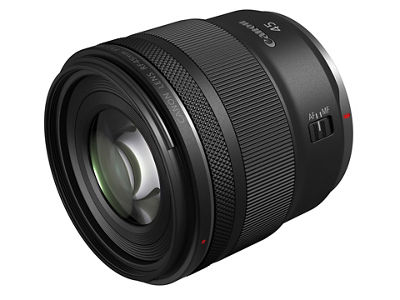
RF45mm F1.2 STM
A lens welcomed by photographers new and old
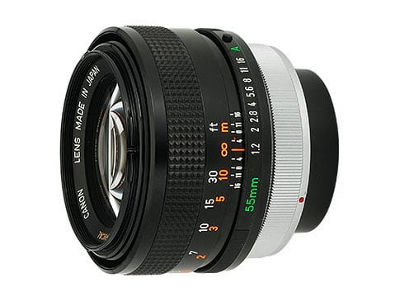
FD55mm F1.2AL, released in March 1971
First, tell us about the inspiration for the lens.
Yasuaki Hagiwara: The DSLR-to-mirrorless transition in 2018 afforded more freedom in lens design from the large diameter and short back focus of the mount, which opened the door to higher-performance lenses. That was great, but at the same time, we wanted to keep lenses with distinctive optical aberration characteristics such as the EF50mm f/1.2L USM in our line.
But we still couldn’t just reissue EF lenses in this format yet, so we started planning a different kind of revival based on the FD55mm F1.2AL, Canon’s first lens with an aspherical element. After reflecting on the design, we knew we could make the lens much smaller. The first step was to find our old technical information on the FD55mm F1.2AL, which you see here.
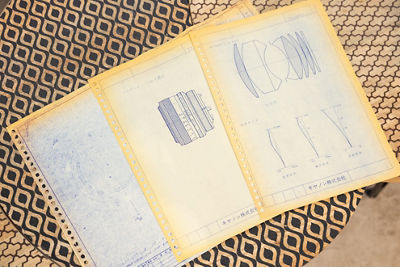
Original FD55mm F1.2AL blueprints found at Canon
- Suzuki: Those are beautiful, hand-drawn blueprints, not CAD printouts. It’s amazing these records still exist.
- Abe: We even tried to recreate this in the design software.
Internally, how did people react to the idea of a product that would offer more than just superb image quality?
- Hagiwara: As you might guess, it was startling and probably before its time. It stirred up emotions that people couldn’t really express well.
- Abe: EOS cameras are engineered for speed, comfort, and high image quality. At that time, we were taking the first step for the RF system by providing a full line of high-performance lenses.
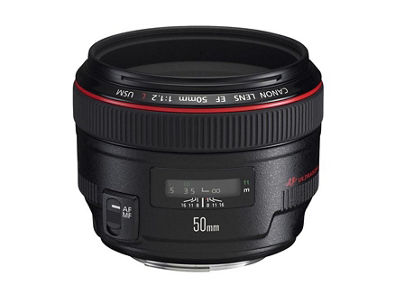
EF50mm f/1.2L USM
- Hagiwara: After keeping the idea for this lens alive as the RF lens line was completed over the next few years, we started working again toward a lens that would recreate the EF50mm f/1.2L USM.
A hallmark of this lens is the amount of aberration near full aperture. How did you decide this?
- Abe: We sought balanced image quality that would satisfy both those wanting a convenient modern lens and those wanting distinctive optical aberration characteristics. To find the right balance, we tested EF lenses, the FD lens mentioned earlier, and other lenses, including some from the Serenar era (in the 1950s).
- Hagiwara: One reason we can’t overemphasize distinctive lens characteristics is that too much aberration can cause problems with current cameras. For example, autofocus might not work correctly.

- Abe: Ultimately we settled on a lens that’s an updated, modern version of the EF50mm f/1.2L USM. Although some users of FD lenses or lenses from the Serenar era might wish for greater blurring, it’s a convenient lens that meets current standards in image quality. We’re proud to have struck a good balance. It’s a lens with a distinctive character, and it’s easy to shoot at f/1.2.
- Suzuki: Shooting with it reminded me of using the EF50mm f/1.2L USM. Tell me about lens image quality. How effective is in-camera correction?
- Abe: Enabling Digital Lens Optimizer enhances the sense of sharpness on the focal plane, and disabling it has a soft focus effect. You can also enjoy some of the inherent vignetting of the lens by disabling peripheral illumination correction, which is enabled by default.

Hagiwara Holding the Original Lens Project Proposal
For an f/1.2 lens, it feels very light. What made this possible?
- Abe: One thing that made the lens much lighter and more affordable is that it’s a double-Gauss lens with AF actuation driven by a geared stepper motor. But because these motors tend to be noisier and the focus group of double-Gauss lenses tends to be larger, with more difficult drive control, we applied insight from past development as our mechanical and electrical design, prototyping, and quality evaluation members worked to ensure both AF speed and quiet operation to bring this lens to market.
- Suzuki: The lens certainly is quiet. Without distracting sounds or noises, I could immerse myself in shooting.
- Abe: This design makes it stress-free, with plastic aspherical elements also keeping it light and more affordable. Advanced plastic molding enables greater freedom in machining and higher precision. It was quite ambitious, and we had never done something like this for a large-aperture f/1.2 lens.
- Mizushima: Like Sayaka, I also shoot as I walk around, so trying it out reminded me how essential it is for lenses to be light.
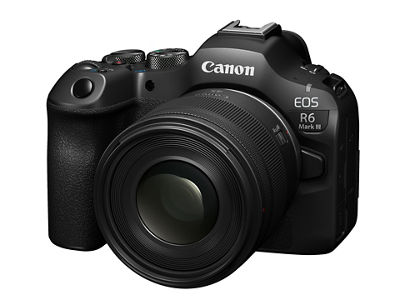
The Lens on an EOS R6 Mark III Mirrorless Camera, Announced at the Same Time
- Suzuki: I was surprised how light it was when I first held it.
How much thought went into controlling flare and ghosting, which can give lenses character?
- Abe: These are controlled but not completely eliminated as on L lenses or others with advanced coatings. These carefully controlled lens effects do give it character.
For a large-aperture prime lens, it looks rather plain and simple.
- Abe: Structurally, the front element is recessed instead of protruding, and because this enhances rigidity, we could make internal parts of plastic. As a result, the lens is light, inexpensive, and well-protected for peace of mind.
Shots by Sayaka Suzuki
Moving on, let’s look at some shots taken with the RF45mm F1.2 STM, starting with Suzuki’s work.
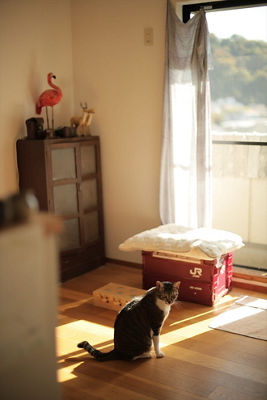
Canon EOS R8 / RF45mm F1.2 STM / Manual exposure (1/1,000 sec., f/1.2) / ISO 250
Photo: Sayaka Suzuki
- Suzuki: This is an ordinary scene at home. Unlike when I use heavy camera gear in familiar places like this – which makes me feel as if I’m arranging my life for photography – using light gear such as this lens makes taking pictures as effortless as breathing. I mainly shoot with 35mm f/1.8 and 50mm f/1.2 lenses, but the RF45mm F1.2 STM is perfect when an f/1.2 lens seems slightly too heavy or a focal length of 50 mm makes the angle of view a little too narrow.
- Mizushima: Nice framing of the cat. I like the background bokeh, too. Camera gear for capturing everyday moments like this certainly seems ideal.
- Abe: We deliberately chose a focal length of 45 mm, which offers a slightly wider angle of view than 50 mm, to encourage casual shooting. A focal length of 40 mm would have made the lens more complex, but the range of 50–60 mm would have been ideal for a double-Gauss lens, so this one was more difficult to design.

Canon EOS R8 / RF45mm F1.2 STM / Manual exposure (1/1,250 sec., f/1.2) / ISO 200
Photo: Sayaka Suzuki
- Suzuki: Here’s another shot at home. With morning sunlight filtering in, I turned the lens on a plant that I haven’t shot much. I thought I’d just grab a camera of mine in the kitchen that had the RF45mm F1.2 STM on it. It was refreshing to use the lens, because I thought I had exhausted all possibilities in this kind of shooting. A 35 mm lens would have captured more of the scene, and a 50 mm lens would have made it more refined, but I think this lens gives it just the right feeling of an ordinary morning.
- Abe: There’s some distinctive ghosting in the lower left. Uniformity in circular bokeh is one point we focused on.
- Hagiwara: The outline of the bokeh is a more pronounced. This kind of circular bokeh is common with double-Gauss lenses.
- Suzuki: It’s beautiful, isn’t it. Oval bokeh without any swirling or points of light in it.

Canon EOS R8 / RF45mm F1.2 STM / Manual exposure (1/1,000 sec., f/1.2) / ISO 400
Photo: Sayaka Suzuki
- Suzuki: I’m usually trying to capture soft, ethereal scenes, and f/1.2 lenses help. These scenes are dreamy, with only some of the subject in focus. This shot in particular was with one hand, and I was surprised that I could shoot one-handed with an f/1.2 lens. The camera also recognized animals well when I was shooting them (although I didn’t use that feature here), and AF was fast enough to track players consistently at a softball game.
- Hagiwara: Initially we had also considered releasing the lens for MF instead of AF, but that seemed somewhat outdated, so it was developed as an AF lens.
- Abe: Actually, it’s impressive that a large-aperture f/1.2 lens that feels this substantial can be used for AF. It was technically challenging to ensure actuator drive precision, durability, and accurate AF control under high-aberration conditions. Because the RF system itself was not originally designed for AF using lenses with considerable optical aberrations, we also reviewed camera control and updated the system.
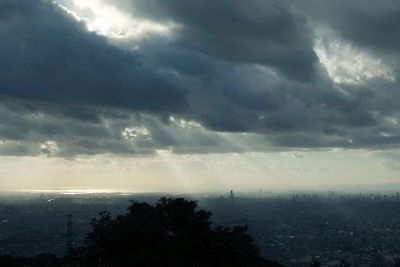
Canon EOS R8 / RF45mm F1.2 STM / Manual exposure (1/400 sec., f/16) / ISO 200
Photo: Sayaka Suzuki
- Suzuki: This is a shot of Osaka from an observation deck. I caught a moment when rays of light were breaking through the clouds. When I notice scenes like this, I’m inclined to replace any lens on the camera for casual shots with a high-performance one, but here, the results surprised me after I just grabbed the camera and shot. The buildings in the distance look quite sharp. This is the best of both worlds – f/1.2 shooting and high apparent resolution.
- Abe: We paid attention to how images change as the aperture is stopped down. Stopping down to over f/8 or so gives a sense of resolution rivaling that of L lenses.
- Hagiwara: Because modern RF lenses resolve well, starting from open aperture, there’s not much change in apparent resolution as the aperture changes. This lens features a balanced design, so that you can enjoy the change from softness at open aperture to sharpness when stopped down.
Shots by Takahiro Mizushima
Next, some shots by Mizushima. This direct portrait is a good example of his work.

Canon EOS R6 Mark III / RF45mm F1.2 STM / Program AE (1/200 sec., f/8.0) / ISO 850 / Flash (E-TTL)
Photo: Takahiro Mizushima
- Mizushima: Here, I shot friends from Taiwan visiting Japan. I arranged the background colors to go well with his stylish blue cap. Using flash made the colors more vivid. The sharpness is impressive, with each hair of his beard distinct. The focal length of 45 mm also gives a nice angle of view. 50 mm would have made it too staged and dramatic. It’s also great to include the background, and the framing can be tighter than with a 35 mm lens.
- Abe: Thanks for mentioning it. Some say the angle of view of a 45 mm lens seems natural, like human vision. Another consideration was that for people used to wide-angle smartphone lenses, a 50 mm angle of view may tend to seem somewhat cramped.
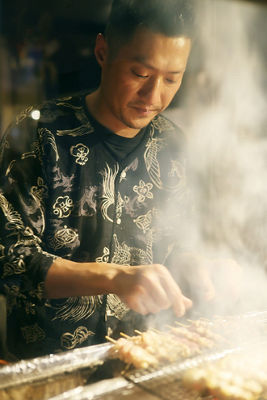
Canon EOS R6 Mark III / RF45mm F1.2 STM / Shutter-priority AE (1/50 sec., f/2.2) / ISO 400
Photo: Takahiro Mizushima
- Mizushima: Here, I captured the head chef at a restaurant where I work part-time. It was a rare chance to photograph him, so I aimed for a glossy magazine shot. For the aperture, I used f/2.2 to keep the image area from the person (the main subject) to the grilled chicken within the depth of field.
- Suzuki: I get the impression that it was taken with an 85 mm lens, but you were actually less than a meter away from him. Even when you’re so close, there’s no distortion, which gives it an interesting, medium-telephoto feeling.
- Mizushima: Thank you. AF was responsive and kept the subject sharp despite the smoke.
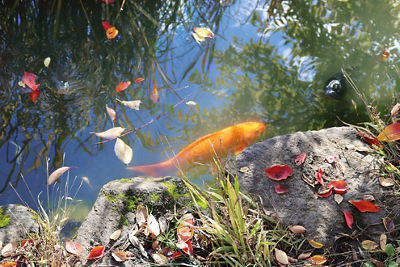
Canon EOS R6 Mark III / RF45mm F1.2 STM / Program AE (1/250 sec., f/5.6) / ISO 400
Photo: Takahiro Mizushima
- Mizushima: This is a shot from my morning walk, when I usually have a compact camera in hand. The sunlight was only there for a moment, but it revealed a variety of colors that makes the shot resemble a painting. I focused on the rocks in the foreground instead of the koi in the center, but this ended up making the koi more intriguing.

Canon EOS R6 Mark III / RF45mm F1.2 STM / Program AE (1/800 sec., f/10) / ISO 640
Photo: Takahiro Mizushima
- Mizushima: I took this photo on an outing to shoot my niece running at a school sports festival. One event got everyone out of their seat to roll a giant ball, so I shot their backpacks. Left behind like that, they looked interesting to me. At a focal length of 45 mm, shots resemble what we’re actually seeing. Being able to shoot athletic events as well as this kind of natural scene with kids makes it easy to recommend a lens like this to parents. And despite my assumption that all lenses are expensive, this one is surprisingly reasonable at $469, which makes it seem like a lens every family should own.
- Suzuki: I also expected it to cost well over $1,000, as an f/1.2 lens.
- Abe: For an f/1.2 lens, this price can’t be beat. We encourage many people to pick one up. Thank you both for sharing your wonderful photography.
Wrapping Up: A Lens by Photography Lovers for Photography Lovers
Will you both continue to use the lens in your work? If so, what style of shots will you take with it?
- Suzuki: I didn’t hesitate to preorder it. It’s a great match for my EOS R8, and it’s affordable. It promises expressive shooting at a time when many photographers have given up on trying to recreate a vintage-lens style with lenses from current industry leaders that aren’t designed for that. I’m glad to have discovered the RF45mm F1.2 STM, which has character, captures sharp images when stopped down, and is a very versatile lens that lets me shoot more freely. I had believed that f/1.2 lenses were generally out of reach or came with some barriers that were not easily overcome, but now I think those boundaries can be crossed.

- Mizushima: Of course I’d like to use the lens, but because I shoot with a film camera, I’ll also need to pick up an EOS R – a distinct possibility with this pricing. The lens also shines in shots of people. Using it in my own work may well change my style dramatically, but I can imagine shooting a new series of portraits with the lens after my current series is finished. It would also be much lighter and tempting to use instead of my medium-format camera that creates a lot of bokeh.

- Suzuki: That’s right. It does seem like a viable second camera for film camera users. The images it tends to produce would seem familiar.
- Mizushima: True, and prints also reveal a different aspect of shots.

- Suzuki: Yes, subtle nuances of lighting in shots bring prints to life. I got the impression that it’s a lens by photography lovers for photography lovers. Notable advances in video have given us a slight feeling that people involved in photography have been left behind. I’m glad to see photography making a comeback.
- Hagiwara: Thank you. We took the approach of exploring what makes photography enjoyable and how lenses can engage our senses. Cameras and lenses have become so advanced that they offer superhuman performance. This is convenient, but some consumers probably feel a disconnect with their own, human senses. We expected some interest in the lens from those who look back fondly on EF or FD lenses, but when preorders began, we were pleasantly surprised at the warm reception among younger generations as well, which we appreciate.
- Mizushima: Younger generations may be seeking something emotionally engaging, something like the warmth of human touch. Use of social media has accelerated since 2020, but we find ourselves craving something quite different. Surely this is the kind of lens that’s needed today. It was great to find that even among those in development who are constantly refining advanced technologies, some people are also attuned to emotions.

Thanks for signing up!
The application has encountered an unknown error. Please try again in a few minutes!
By clicking Sign Up, you are opting to receive promotional, educational, e-commerce and product registration emails from Canon USA. You can update your preferences or unsubscribe at anytime.