


The Intelligent Era of IT: How Managed Services Are Helping Organizations Navigate Complexity in 2026
In today’s enterprise landscape, basic cloud adoption and routine IT automation are no longer competitive differentiators. They are now baseline prerequisites. As digital environments become increasingly complex, business leaders face a dual challenge: managing intricate hybrid infrastructures while defending against escalating cyber risks.
To maintain agility and resilience, forward-thinking organizations are moving away from reactive internal IT management and toward strategic managed IT partnerships. According to Gartner® in its report Hype Cycle for Managed IT Services, 2026, the overarching priority for enterprise technology has fundamentally transformed:
"The era of basic cloud and automation has become a foundational prerequisite. Instead, the hype has aggressively shifted toward converged intelligence, where AI, data, and automation are deeply embedded at every layer of the digital ecosystem." Footnote1
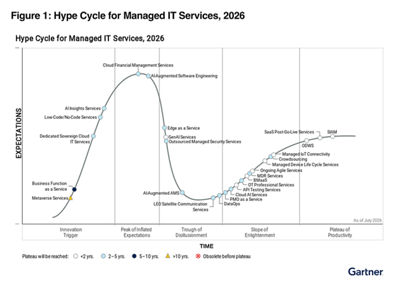
Understanding why now is the ideal time to adopt a Managed IT Service model requires examining the primary market forces driving this shift.
- Bridging the Persistent IT Talent Deficit and Evolving Threat Landscape
One of the most pressing operational challenges facing enterprises today is the global shortage of specialized technical talent. Recruiting, training, and retaining internal experts to staff a 24/7 Security Operations Center (SOC) or manage complex cloud environments has become cost-prohibitive for many organizations.
At the same time, the risk environment has intensified. Gartner highlights that outsourced managed security services (MSS) are essential, driven by "a relentless cyberthreat landscape and a persistent global talent shortage." Modern managed services allow businesses to shift "from reactive monitoring to proactive, AI-integrated threat defense and continuous exposure management." Footnote1
- Navigating the AI Shift: From Hype to Operational Reality
Artificial intelligence is rapidly rewriting operational expectations across every industry. Gartner projects that "by 2028, 60% of IT services will be powered by generative AI (GenAI) and hyperautomation, radically changing the IT services buyer landscape." Footnote1
However, successfully implementing GenAI, multiagent orchestration, and other emerging AI capabilities requires specialized expertise, infrastructure, and governance. Gartner notes “managed IT service providers are expanding their role as 'AI-first' strategic partners that help organizations manage complexity across hybrid environments, improve operational performance, and maintain robust security.” Footnote1
- Controlling Component Inflation and Cloud Financial Friction
Financial discipline around technology investments is under intense scrutiny. Unoptimized cloud migrations and hardware inflation are creating noticeable budget strain across business sectors:
- Cloud Dissatisfaction: Gartner projects that "by 2028, 30% of organizations will report significant dissatisfaction with cloud adoption, mainly due to unrealistic expectations, suboptimal implementation practices, and poor cloud financial management." Footnote1
- Hardware Cost Pressures: Gartner notes that "for managed device life cycle services, the increasing cost of hardware components is driving the urgency and investigation into these solutions." Footnote1
Without structured Cloud Financial Management (FinOps) and proactive device lifecycle oversight, organizations face spiraling operational expenditures and accumulated technical debt.
- Elevating the Digital Employee Experience (DEX)
In hybrid and distributed work environments, legacy IT support models that measure success solely by ticket closure speed are no longer sufficient. Organizations are increasingly prioritizing the broader Digital Employee Experience (DEX), focusing on how technology impacts employee productivity, satisfaction, and engagement.
By adopting more proactive workplace management strategies, including persona-based support models, automation, and self-healing technologies, organizations can create smoother technology experiences and improve workforce productivity.
These challenges highlight a broader shift: organizations no longer need technology solutions alone; they need strategic guidance, operational expertise, and ongoing support to maximize their investments.
Building a More Strategic IT Future with Managed IT Services
The challenges shaping today’s technology landscape require organizations to think beyond maintaining IT systems and focus on building a more strategic approach to technology management. Managed IT Services provide organizations with access to specialized expertise, proactive support, and the resources needed to navigate evolving technology demands.
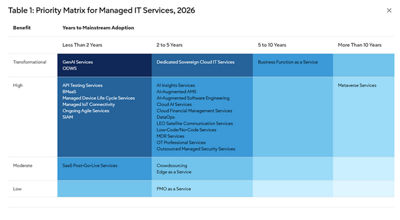
Canon Managed IT Services help organizations address these challenges by providing comprehensive IT support designed to improve operational efficiency, strengthen security, and support long-term technology goals. By combining IT expertise with capabilities across infrastructure management, cloud services, cybersecurity, and ongoing support, Canon helps organizations build a more resilient technology foundation while allowing internal teams to focus on strategic business priorities.
Footnote
Gartner, Inc., Hype Cycle for Managed IT Services, 2026, Nathan Davie, Jess Aggio, July 27, 2026.
Gartner and Hype Cycle are trademarks of Gartner, Inc. and/or its affiliates.
Gartner does not endorse any company, vendor, product, or service depicted in its publications, and does not advise technology users to select only those vendors with the highest ratings or other designation. Gartner publications consist of the opinions of Gartner’s business and technology insights organization and should not be construed as statements of fact. Gartner is a consultant to Canon and has received compensation for its services and its contribution to this publication. Gartner disclaims all warranties, expressed or implied, with respect to this publication, including any warranties of merchantability or fitness for a particular purpose.
This graphic was published by Gartner, Inc. as part of a larger research document and should be evaluated in the context of the entire document. The Gartner document is available upon request from Canon.