


Matching the Right Record to the Right Patient
Every healthcare visit begins the same way: Someone has to confirm who the patient is. That single step, involving a wristband scan, an insurance card, and/ or a driver's license, anchors everything that follows. Every order, note, and lab result is attached to whatever identity gets captured in that first moment. If all information is captured correctly, the rest of the visit runs on solid ground. If it’s captured incorrectly, though, the error travels with the patient through registration, treatment, and billing. In a clinical setting, a misidentified patient isn’t just an administrative mistake—it represents a serious operational vulnerability that can compromise patient safety efforts, delay care, or contribute to treatment and medication discrepancies. What’s worse, any errors are often invisible until something forces them into view.
Patient identification happens more than once. It repeats across a visit: at registration, at each department a patient moves through, at every specimen collected or medication administered. Getting it right consistently, and not just at the front desk, is what actually protects patients and the records that are built around them.
Where Identification Happens
Identification touches more of the visit than appearances might suggest. Registration captures a patient's identity from an insurance card or ID. A wristband carries that identity onto the floor, and from there it has to be checked and re-checked by every person who interacts with that patient for the duration of the stay. Specimen labels, prescription labels, and imaging orders must each be matched back to the same patient, often by staff members who never saw the original registration and are relying entirely on what's printed in front of them.

According to Keypoint Intelligence®’s research, nearly half of healthcare firms use scanners on a daily basis to perform specialized document capture (including ID and receipt-type documents). This is the highest daily-use rate of any scanning task measured in the study. That volume confirms that identification capture is not a task that’s confined to a single desk or shift. It is now central to daily operations.Footnote1
Specialized Document Capture (IDs, Receipts)
Thinking about the dedicated scanners in your organization, how often are they used for document capture (including IDs and receipts)?
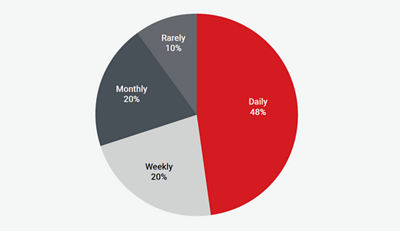
N = 41 Healthcare Respondents in the United States
Source: Office Group Printing and Scanning Survey, Keypoint Intelligence 2025
Far from a step that happens once at intake and then recedes into the background, identification is repeated dozens of times a day, across departments, shifts, and staff members who don't always share the same tools or processes. A nurse checking a wristband, a lab tech confirming a specimen label, and a pharmacy verifying a prescription are all performing the same fundamental task with different tools and different levels of built-in verification.
The Cost of a Mismatch
When identification goes wrong, the consequences rarely stay contained to a single record. A misread name or a duplicate registration might result in the creation of two charts for the same patient, splitting a history that clinicians must see completely at the exact moment they need it most. A mislabeled specimen can delay a diagnosis, or worse, attach the results to the wrong person entirely. Alarmingly, this risk grows with every additional handoff that a sample passes through. Billing errors can further compound the problem, generating rework long after the clinical visit has ended. This makes the original mistake difficult to trace back to its source.
Many organizations rely on a single verification step, usually at registration, to prevent these errors before they occur. That single check makes sense as a first line of defense, but it assumes that nothing changes between intake and the rest of the visit. Unfortunately, care rarely remains that static. Because a single early check at intake can’t account for everything that happens afterward, a more reliable approach adds a verification checkpoint at each major handoff, registration, specimen collection, and medication administration.
This doesn't need to be a complicated process. Even a quick two-point check (e.g., name and date of birth confirmed against the wristband) at each handoff meaningfully reduces the number of errors that make it further downstream. The added time per check is minimal, but the reduction in downstream rework and risk is not.
Capturing Information Once, Using It Everywhere
Every re-entry of the same information is a chance for error, and it also costs staff members their time. Keypoint Intelligence®’s research1 found that accelerating patient intake with intelligent form capture is a top document-related priority for 40% of healthcare IT organizations. That priority reflects a shift away from manually keying information from an ID or insurance card and toward capturing it once, digitally, straight from the source document at the point of intake.
When captured this way, identity information can flow directly into registration, the EHR, and any specialty printing that follows (e.g., wristbands, labels, forms) without requiring staff to re-type the same details at each step. A patient's name, date of birth, and identifying information can get pulled once from a scanned ID or insurance card, and every downstream system will reference that same original capture rather than a fresh, independently typed version.
Speed is part of the appeal because intake certainly moves faster this way, but accuracy is the bigger win. Every manual re-entry is an opportunity for a typo or transposed digit to enter the record, and those small errors are exactly the kind that cause mismatches later. Rather than showing up at registration where they're introduced, they occur downstream, at the specimen label or the wristband, when they're far more difficult to trace back to their source.

Specialty Printing in Clinical Settings
Even after a patient’s identity is captured correctly, it still has to physically travel with the patient and their specimens. This is where specialty printing comes in. Wristbands, specimen labels, prescription labels, and staff or visitor badges each carry their own requirements, and none of them can simply borrow the format used for a general office document.
For example:
- Specimen labels need barcodes that scan reliably at the lab, often under time pressure.
- Wristbands need to survive handwashing, alcohol swabs, and multi-day hospital stays without smearing or peeling.
- Prescription labels must meet specific regulatory formatting that will vary depending on the medication and jurisdiction.
These varied needs often leave healthcare organizations running a patchwork of specialty printers. There might be one system for wristbands, another for labels, and another for badges. Additionally, each of these systems may be supported differently, often by different vendors, with different supply chains and different points of failure. Standardizing on fewer specialty print formats and platforms, where clinically appropriate, reduces the number of systems that IT and facilities teams need to support, and it does so without compromising the format requirements each document type actually needs. A single, well-supported platform that can handle multiple specialty print formats is often more reliable than several narrowly scoped systems that are all doing different jobs.
Keeping Specialty Printing Reliable
The failure of a specialty printer creates a different kind of urgency than a general office printer going down. A wristband printer that's out of ribbon at registration will stop intake entirely, since there's no way to move a patient forward without one. A mislabeled specimen printer can send a sample to the lab without a readable barcode, forcing staff members to locate the patient to re-collect what should have been captured the first time. When an unreadable barcode delays an urgent stat-lab result or an illegible wristband halts a scheduled surgery, hardware unreliability ceases to be an IT ticket—it can introduce operational bottlenecks that disrupt clinical efficiency and impact patient throughput. These aren't inconveniences that can wait for the next scheduled service visit; they interrupt care in progress.
Specialty devices benefit from being monitored and supplied separately from the general print fleet. Alerts are set for supply levels and device status specifically at the locations where identification and labeling happen, including registration desks, nursing stations, and specimen collection areas. General fleet management that is built around office printers with predictable, lower-stakes usage patterns doesn't account for how immediately a specialty device failure affects patient care.
A quick daily check of supply levels at these specific points, built into existing shift routines, will catch most failures before they interrupt a patient encounter. Pairing that daily check with automated low-supply alerts gives staff members a second layer of warning before a device can run out mid-shift.

Better Identification, Better Care
Patient identification and specialty printing rarely get discussed as a single topic, but they're two halves of the same task: Confirming who a patient is, and making sure that identity travels accurately with them through the duration of their care. Getting the first part right depends on capturing information once and verifying it consistently at each handoff, not just at intake. Getting the second part right involves treating specialty printing as its own category with its own reliability standards, not just an afterthought within the broader print environment.
Organizations that treat both components as connected pieces of the same task, rather than separate administrative chores, can build a foundation that the rest of the visit can rely on. The process will hold up not just at registration, but at every point where a patient's identity must be confirmed again.
Supporting accurate patient identity verification is significantly enhanced by a highly integrated ecosystem—combining high-speed, intelligent ID capture with reliable specialty printing workflows. Canon’s healthcare document capture hardware and integrated workflow solutions excel at helping empower health systems to streamline administrative processes and support clinical efficiency.
Footnote
- Source: Digital Transformation IT Decision-Maker Survey; Keypoint Intelligence 2025.

CONTACT A CANON SALES REPRESENTATIVE